Category: New York City

Layup Line: NBA Playoffs Game 2 Edition

1) Dwyane Wade dribbles too much.

2) Why is Dwyane Wade allowed to throw his teammates under the bus?

3) I’m not sure I understand why OKC didn’t get a veteran point guard? Not so much because Westbrook is too erratic, but it’s unclear how his growing/learning curve really aligns with Green and Durant’s.

4) Why did anyone ever think Tyrus Thomas is a better basketball player than Glen Davis?

5) Why haven’t the Knicks hired Glen Davis’ personal trainer to help Eddy Curry?

A Surge For Haiti?

Below is an excerpt from a new entry published on Americas Quarterly

One wonders though: a surge in Haitian-American volunteerism after the earthquake was inevitable, but the question is if this revamped volunteerism is sustainable. After all, when it comes to Haiti, progress is seemingly embodied by a gaggle of constantly emerging organizations and individuals seeking to improve life. Far too often these efforts have either been too overwhelming, too redundant, too sporadic, or at the very least exhibiting poor coordination between different groups. Without a clearer consensus on the historical legacy that these ventures are building on, progress in Haiti risks being relegated to being more of a verb than a noun.

Click here for more

Layup Line: 2010 NBA Playoffs Edition(s)

I couldn’t resist reviving the Layup Line now that this year’s NBA Playoffs have begun.  So here goes:

  1. If Shaq wins a championship, what’s his legacy?  Will he be remembered as the greatest center of all-time?  Will he be remembered as the best mercenary? Underachiever? What does Shaq mean to the history of the NBA?  While ABC & ESPN spend every other second reminding us that Kobe is great, no one has stepped to the line to take a closer look at Shaq’s legacy.  Few seem to recall that Shaq is the lone superstar (?) of his era that has delivered on the championship aspirations signaled by their arrival into the NBA.  Think of his peers: Grant Hill, Jason Kidd, Chris Webber; Jimmy Jackson; Penny Hardaway; Christian Laetner; Alonzo Mourning; Dikembe Mutombo.  Some of these players have had Hall of Fame careers of their own, and Mourning did in fact win a championship with Shaq and the Heat, so it’s not to say that they were a lost generation, but since Shaq is their marquee player, they don’t have a defined brand like the Jordan, Kobe and now Lebron eras.
  1. Speaking of Kobe: has there ever been another player who’s greatness has been so over-touted?  I’m not saying Kobe’s overrated, he’s not, but the NBA and its media auxiliaries ABC & ESPN have displayed a bizarre obsession over the past two years with reminding readers that he’s great.  What are they afraid of?  That someone out there might still be arguing that Vince Carter or Tracy McGrady is better than Kobe, or that the Lakers should have accepted the Clippers Quentin Richardson & Darius Miles trade offer?
  1. Kevin Garnett is the best complimentary player of his generation.  He’s Scottie Pippen with a better scowl, less of a handle, but more favorable media treatment and way more money
  1. The Spurs are a split between the late 80s Celtics when Bird, Parish and McHale were at the tale end of their careers, and the early 2000s version of the Utah Jazz where Stockton and Malone always seemed to have enough to get them to a conference finals, but not enough legs to get any further.  All that to say…
  1. The Spurs should trade Tim Duncan to the Orlando Magic and start rebuilding.  This can not be a straight up trade, but let’s say a scenario where San Antonio sends Duncan to Orlando, then agrees to a sign and trade with Chris Bosh and some spare parts, then suddenly they’re a step closer toward at least the middle of the pack in the West.  Duncan gets to be David Robinson to Dwight Howard’s Tim Duncan, win another title or two and retire closer to home.

The Black Church is Not Dead: A Response

In the introduction to his book on writing, Ben Yagoda tells an anecdote about acclaimed New Yorker editor Harold Ross’s “one man crusade against the word the.” As Yagoda contends, Ross “maintained [the] should be used only to introduce a noun or noun phrase designating a unique entity.”  I was reminded of this story when I read Princeton University Professor’s Eddie Glaude’s HuffPo entry announcing the Black Church’s death.  If one were to really engage Glaude in this rhetorical exercise, the end result would not be to proclaim that the black church is dead, but rather that it never existed to begin with.

That said, if one should never play poker with a card shark, it might be prudent to avoid philosophizing with a philosopher.  So instead, I will try another approach.  A few years ago, I sat in a room with about 40 other black men for a bi-weekly meeting of Emmanuel Baptist Church’s men’s ministry, The Frontliners.  On this particular evening I had brought two friends along and afterward I inquired about their responses to participating in this gathering.  I couldn’t let them finish before interjecting about why I am usually so moved by attending these meetings.  One of the things that I mentioned is that it was a rare space in my life where terms like “men of color” “people of color” and for the most part “black men” was rarely bandied about.  With black men making up a majority of participants at these meetings, it was often unnecessary to reassert our blackness as it were.  The obstacles and promises that lay before us were to be approached as men.  These conversations were a breath of fresh air from ones taking place in other circles that tended to focus, and at times maybe even over-emphasize purported short-comings of black men.  As time wore on I was inspired watching these men do community service work in area soup-kitchens, participate in habitat for humanity projects, mentor young men in our area and more recently become more deliberate in developing a health agenda and coordinating Saturday walk-jogs & rides in Brooklyn’s Prospect Park to get Frontliners to partake in physical activities.

Being the good scholar that I am, I eventually thought about writing an article or something about these black men at this black church.  You could imagine my surprise then when reading through Clarence Taylor’s history of The Black Churches in Brooklyn, I didn’t find Emmanuel Baptist’s name.  For sure, Taylor had make a mistake, because the coteries of newly minted Spelman, Morehouse and Florida A&M alumni who migrated to EBC every year upon arriving in New York could not be wrong, and judging from testimonials by older members of their salad days spent in EBC’s pews, I presumed that Emmanuel Baptist Church, is, and always has been a black church.

Of course Taylor was correct; thus, while Emmanuel Baptist Church boasts a black majority, it was never a black church.

Churches, as I have learned are not defined solely by the racial or ethnic makeup of those sitting in pews on weekends, but rather by the commitment, ingenuity and service of their members.  Given migration patterns in this country, it makes sense that at varying points some churches will boast black, latino or white majorities.  We are also learning that many churches will also have to contend with declining memberships, leaving their immaculate edifices underutilized, and their communities under-served. Therefore, if Glaude’s purpose in his entry is to claim that black churches are changing and their roles within black communities are changing, then this is a fact that goes without saying.

However, if his intent is to truly proclaim the death of “the black church,” then I would like him to identify this specific church so that I may know to whom to address my condolences.

Where is the Ground For Haitian Americans

Excerpt from my opening remarks at Tuesday’s Hofstra University’s Day/Night For Haiti

On The Ground — or — Where is the ground for Haitian Americans?

Arguably the most ubiquitous term to emerge in Haitian-American parlance in the aftermath of January 12th’s earthquake is “on the ground.”  This term as you all know refers to the process of traveling to Haiti to help with earthquake relief.  It is slightly ambiguous because for many Haitian Americans how one can help once “on the ground” after the earthquake was slightly ambiguous.  The idea was, once “on the ground,” it would immediately become evident how to help.

The more I heard this term, I couldn’t help but consider the tragic irony embedded in its proliferation.  The last thing that Port au Prince needed was more Haitians “on the ground,” yet here were a about half a million others pining to do just that.  This term eventually brought to mind a memory from childhood.  Upon returning home from work one day and discovering that the roof of our apt had collapsed, my father chided my mother (who I should mention was about six months pregnant with my brother) for not getting on the ground and immersing herself in the debris.  It was his contention that this would have been great grounds for a lawsuit, after all, what court wouldn’t sympathize with the image of a pregnant woman buried under a collapsed roof?

As Dad acted out what his response would have been had he been home when this roof collapsed, the more farcical his plot became.  Not only should my mother have rolled around in this debris, but she (I guess now would be a good time to tell you that the roof collapsed in our bathtub) should have pulled me into the tub and bathed me in the debris as well.  After all what court wouldn’t side with the image of a pregnant woman and her son buried under a collapsed roof?

Select Writings

WASHINGTON POST

In a year in which student activism and free speech issues have dominated conversations on many campuses, and beyond, [Ferentz Lafargue] takes on the concerns of those who argue that students today are too quick to take offense at others’ language and perceived biases.

THE FEMINIST WIRE

This article is part of the #LoveWITHAccountability forum on The Feminist Wire. The purpose of this forum and the #LoveWITHAccountability project is to prioritize child sexual abuse, healing, and justice in national dialogues and work on racial justice and gender-based violence.

AMERICAS QUARTERLY

Americas Quarterly: The Policy Journal for Our Hemisphere is the only magazine dedicated to policy analysis and debate of economics, finance, social development, and politics in the Western Hemisphere.

NEXT AMERICAN CITY

Next American City is a national quarterly magazine about making cities better. Next American City is dedicated to promoting socially and environmentally sustainable economic growth in America’s cities and examining how and why our built environment, economy, society and culture are changing.

HUFFINGTON POST

From January 2008 through December 2009 I was a blogger contributing two-dozen articles to The Huffington Post, an internationally recognized website visited by over 100k readers a day. My entries addressed such topics as the 40th anniversary of Dr. Martin Luther King Jr.’s assassination, April 2008’s food crisis, and the resignation of White House Green Jobs Czar, Van Jones. The bulk of these articles focused on the 2008 Presidential election and featured commentary exploring the recent fascination with marriage in American electoral politics, an alternative take on notion of “white voters,” and a response to Barack Obama’s speech on race in America delivered in Philiadelphia, PA in March 2008.

215 MAGAZINE

“After spending the better half of two years, trying to rein in his black players after what he once believed was the league’s saddest day, David Stern must excavate the NBA from a tarn-filled terrain not seen in professional sports since the gambling allegations first surfaced against baseball legend Pete Rose.”

JANUARY 12th

In the aftermath of the January 12th 2010 earthquake in Haiti I was approached by the following publications Next American City; Social Science Research Council; and Social Text to contribute essays exploring Haitian American responses to this tragedy.  These essays addressed issues such as Haiti’s historical battles to against poverty and political instability, post January 12 public service on the island, and how advances in technology have impacted the quest to uncover relatives immediately after the earthquake.  The essay appearing in Next American City was NAC’s lone piece of writing about this earthquake, while the essays appearing in the SSRC and Social Text venues were part of forums convened by both organizations featuring scholars from a variety of disciplines offering their insights on this tragedy.

The Creative Community: David Starkey Interviews Nadege Clitandre

The Creative Community: Nadege Clitandre from The Santa Barbara Channels on Vimeo.

David Starkey interviews Dr. Nadege Clitandre, Poet & Executive Director of Haiti Soleil an organization focused on building and developing community-centered public libraries, museums, and other institutions of educational and cultural exchange focused on advancing the intellectual growth of young Haitian citizens.

Hofstra University| A Day For Haiti | A Night For Haiti

Hofstra For Haiti

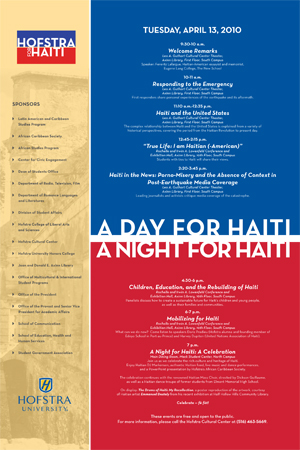
I will be delivering the opening remarks at Hofstra University’s A Day for Haiti on Tuesday April 13th.  More info on the day’s events are available below and here

On Tuesday, April 13, 2010, Hofstra will host “A Day for Haiti”, a full day conference examining the relief and rebuilding  efforts, the media coverage, the issues impacting children and education, the role of the United States, and the post-earthquake experiences of Haitian-Americans. The conference begins at 9:30am in the Leo A. Guthart Cultural Center Theatre, and the “Day for Haiti” will be followed by a “A Night for Haiti” which kicks-off at 7:00pm in the Main Dining Room in Mack Student Center. Join us as we celebrate the rich culture and heritage of Haiti.  Enjoy Haitian DJ Markensen, authentic Haitian food, live music and Haitian dance performances, and the renowned Haitian Mass Choir, directed by Dickson Guillaume. Both events are free and open to the entire campus community and to the public. For more information you may download the entire conference schedule here. Questions can be directed to the Hofstra Cultural Center at 516-463-5669.

Health Challenges for the 21st Century: Bad Sugar

Health Challenges for the 21st Century: Film and Panel Series
Tuesday March 23: Bad Sugar: Diabetes in Marginalized Communities
6:00-8:30pm 529 80 Fifth Avenue (holds 30)
The documentary Bad Sugar addresses this vexing question: What happened to the health of the Pima? Along with The Tohono O’odham Indians of southern Arizona, the Pima have arguably the highest diabetes rates in the world – half of all adults are afflicted. But a century ago, diabetes was virtually unknown in their community. Researchers have poked and prodded the Pima for decades in search of a sociological – or more recently, genetic – explanation for their high rates of disease.   Speakers at this event will relate the experiences of the Pima to the current diabetes epidemic in New York City and address efforts currently underway attempting to curtail its proliferation in New York. Participants include: Kimberly Libman, Faculty Food Studies, The New School for General Studies; Rachel Knopf,. Health Educator, The New School; and Lorraine Mongiello, Project Director for the CUNY Campaign Against Diabetes. http://www.unnaturalcauses.org/episode_descriptions.php?page=4
FREE. RSVP to langscience@newschool.edu

Teach In: Haiti at THE NEW SCHOOL February 17th

Teach In: Haiti

February 17

6:00 pm – Wollman Hall

65 West 11th Street, 5th Floor

On January 12, 2010, several cities on the island of Haiti, including its capital Port au Prince, were leveled by an earthquake measuring 7.3 on the Richter scale. In the aftermath, the world has responded with an outpouring of both financial and emotional support. Media coverage has been round the clock, thus a country that had been long rendered as an afterthought, suddenly became the center of the world. January 12th’s earthquake is as reflective of Haiti’s past as its present, and on February 17th we will gather to explore the earthquake, its aftermath, and the most pressing question of all– how does Haiti recover from a disaster of this magnitude?